Your sales team spends 65% of their time on tasks that don’t involve selling — logging data, writing follow-up emails, updating CRM records, researching prospects. AI agents don’t just automate these tasks; they handle them autonomously, in real-time, at scale, and with the context awareness that rules-based automation never achieved.
This guide covers how AI agents transform every stage of the sales pipeline, the specific patterns that deliver measurable ROI, and the implementation roadmap that takes you from pilot to production.
Why AI Agents, Not Just Automation
Traditional sales automation — sequences in HubSpot, email drips in Mailchimp, lead scoring formulas — follows rigid rules. “If lead score > 80, assign to senior rep. If no response in 3 days, send follow-up.” These break down when:
- Prospects respond unpredictably: A “not interested” reply might mean “not now” or “never.” Rules can’t tell the difference.
- Context matters more than triggers: A lead who downloaded a pricing guide and visited the enterprise page needs different handling than one who read a beginner blog post.
- Speed wins: The first vendor to respond wins 78% of deals. Automation queues responses; agents deliver them instantly with context.
AI agents operate with understanding, not just triggers. They read the content of a prospect’s email, assess intent, and take the right next action — without waiting for a human to review.
For the foundational architecture behind these agents, see our AI Agent Architecture guide.
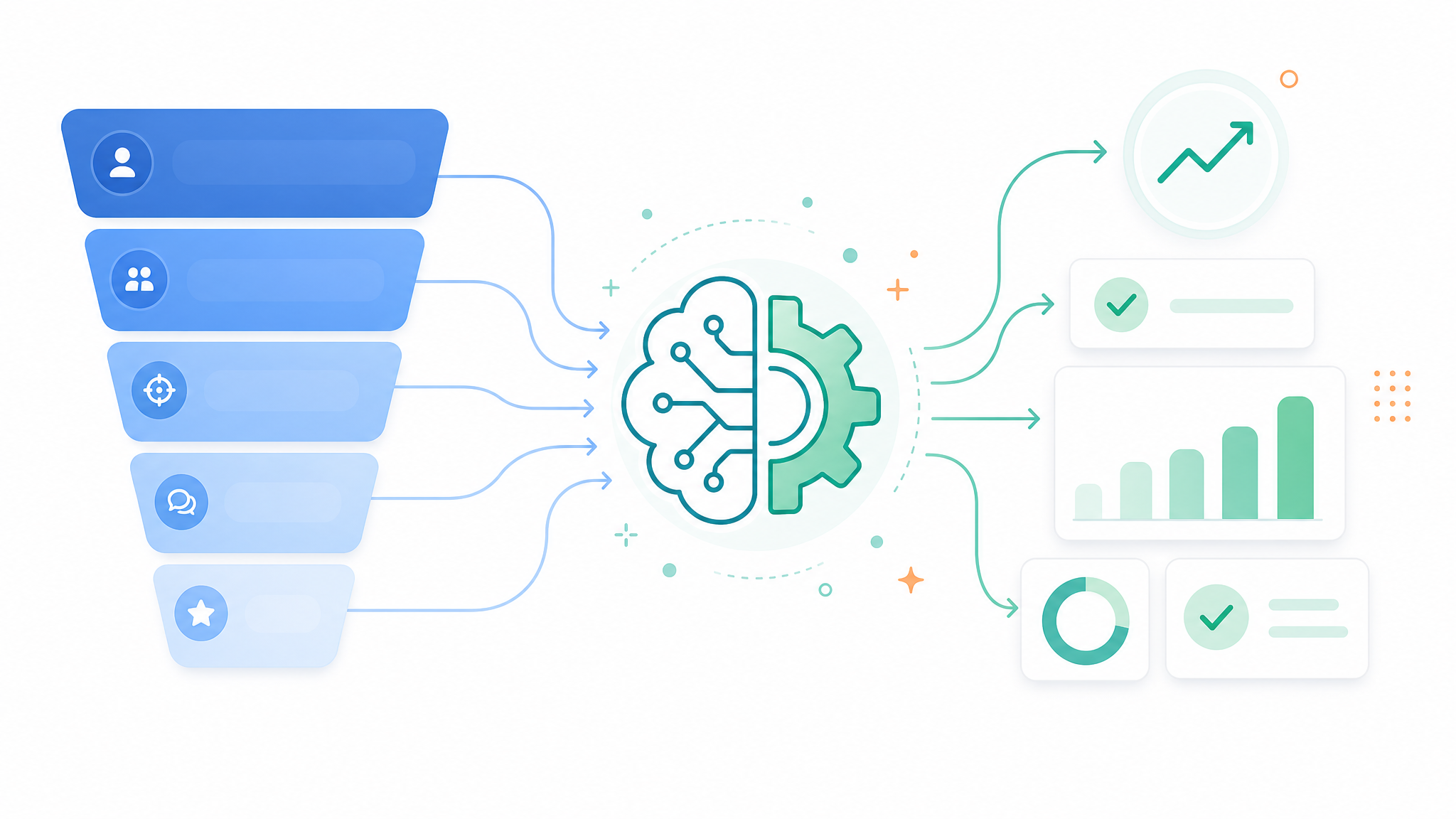
The Sales Pipeline, Automated by Agents
Stage 1: Lead Qualification
What agents do: Evaluate incoming leads against your ideal customer profile (ICP) using multiple signals — company size, industry, role, engagement history, intent data — and assign priority scores with reasoning.
How it works:
1. New lead arrives (form fill, email, chat, referral)
2. Agent pulls firmographic data from enrichment tools
3. Agent checks engagement history across all touchpoints
4. Agent scores against ICP criteria with explainable reasoning
5. Agent routes to the right rep or sequence, with context brief
What this replaces: Manual lead review (average 3-day delay), static scoring models that can’t adapt, and the 27% of leads that never get a response at all.
Agent pattern: Single agent with tool access to CRM, enrichment API, and communication channels. Uses policy-as-code to enforce qualification criteria — agents don’t skip steps or skip leads.
Stage 2: Personalized Outreach
What agents do: Draft and send personalized outreach based on prospect context — recent news, company announcements, shared connections, engagement history — not generic templates.
How it works:
1. Agent identifies a qualified lead needing outreach
2. Agent researches: recent company news, social posts, mutual connections, past interactions
3. Agent drafts outreach tailored to the prospect’s context
4. Policy engine checks: correct tone, no claims beyond what evidence supports, compliance with outreach rules
5. Agent sends via the right channel (email, LinkedIn, chat) with optimal timing
What this replaces: Generic sequences with {first_name} personalization, hours of manual research per prospect, and the “spray and pray” approach that converts at 1-3%.
Agent pattern: Research agent + drafting agent + compliance check. Multi-agent pipeline where each specialist handles its phase, with approval gates for outbound communications (see our Security & Guardrails guide for HITL patterns).
Stage 3: Follow-Up Sequences
What agents do: Manage the entire follow-up cadence — reading replies, assessing intent, and responding appropriately rather than sending a predetermined sequence regardless of what the prospect says.
How it works:
1. Prospect responds (or doesn’t)
2. Agent reads the response and classifies intent: interested, not now, not interested, needs info, objection
3. Agent takes the appropriate next action: schedule a call, send more info, add to nurture, remove from sequence
4. Agent adjusts cadence based on engagement signals
5. Agent briefs the human rep on key developments
What this replaces: “Just checking in” follow-ups that annoy prospects, the 80% of leads that go cold after first contact, and the average 8 touches needed before a response.
Agent pattern: Conversation agent with memory. Maintains context across the entire sequence. Escalates to human rep when: prospect asks pricing, mentions competitors, expresses dissatisfaction with current solution, or signals readiness to buy.
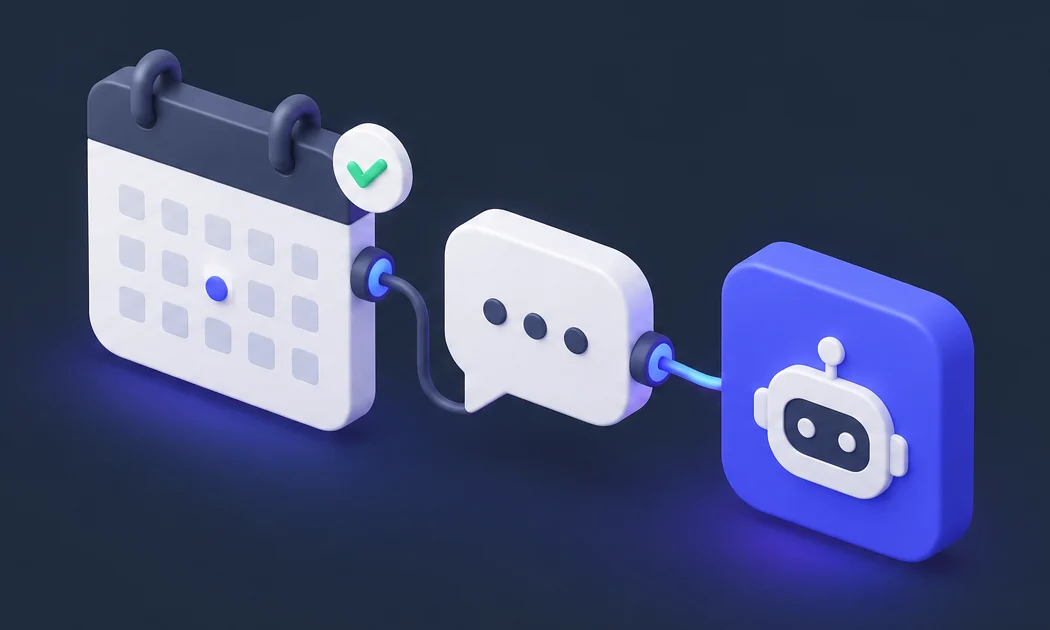
Stage 4: Meeting Scheduling and Prep
What agents do: Handle the back-and-forth of scheduling, prepare meeting briefs, and ensure reps walk into every call fully informed.
How it works:
1. Prospect agrees to a meeting
2. Agent checks rep availability and proposes times
3. Agent sends calendar invite with video link and agenda
4. Agent compiles a meeting brief: company context, prospect background, relevant interactions, competitive intelligence, suggested talk tracks
5. Agent follows up after the meeting with notes, action items, and next steps
What this replaces: The average 4.2 emails it takes to schedule a meeting, the “I forgot to research” problem, and the 30% of post-meeting follow-ups that never happen.
Stage 5: Pipeline Management and Forecasting
What agents do: Keep CRM data accurate in real-time, update deal stages based on actual signals rather than rep self-reporting, and provide more accurate forecasts.
How it works:
1. Agent monitors all deal signals: email exchanges, meeting attendance, document views, contract redlines
2. Agent updates CRM stages automatically based on actual buyer behavior
3. Agent flags deals at risk (went dark, competitor mentioned, champion left)
4. Agent provides forecast data based on signal-based probability rather than rep optimism
5. Agent surfaces insights: “Three deals in discovery mentioned budget concerns — should we adjust messaging?”
What this replaces: CRM data that’s 40% stale, forecasting based on gut feeling, and the quarter-end surprise deals that close early and expected deals that slip.
Implementation Patterns
Pattern 1: Single Agent with Tool Belt
Best for: Small teams, early experiments, specific use cases.
One agent with access to your CRM, email, calendar, and research tools. It handles one stage of the pipeline end-to-end. Simple to implement, easy to monitor, good for proving value before scaling.

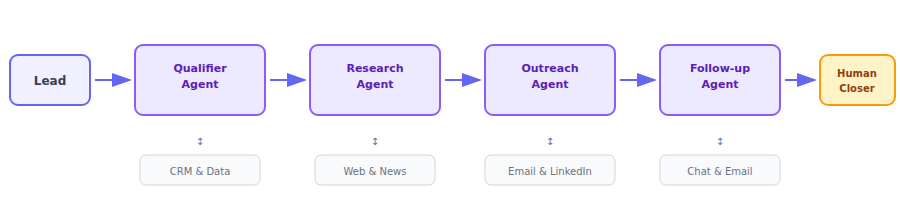
Pattern 2: Multi-Agent Pipeline
Best for: Mid-size teams, full-pipeline automation, organizations with distinct team roles.
Specialized agents for each stage, orchestrated by a coordinator agent. Each agent is an expert in its domain — qualification, research, outreach, follow-up. The coordinator routes work between them and maintains shared context.
For orchestration patterns, see our How Multi-Agent Systems Work guide.
Pattern 3: Copilot Mode
Best for: Enterprise teams, regulated industries, teams transitioning from manual to automated.
Agent suggests actions; human approves and executes. The agent prepares research, drafts emails, suggests next steps, and the rep decides what to send. This builds trust incrementally and maintains human control over high-stakes communications.
ROI: The Numbers
Cost Savings
| Task | Manual Time/Week | Agent Time/Week | Savings |
|---|---|---|---|
| Lead qualification | 8 hours | 1 hour (review) | 87% |
| Research & prep | 6 hours | 30 minutes | 92% |
| Follow-up emails | 5 hours | 30 minutes | 90% |
| CRM data entry | 4 hours | 0 (automated) | 100% |
| Meeting scheduling | 2 hours | 15 minutes | 87% |
| Total | 25 hours | 2.5 hours | 90% |
Revenue Impact
- Response time: From hours to seconds — 78% of deals go to the first responder
- Lead coverage: From 73% contacted within 24 hours to 100% contacted within 5 minutes
- Pipeline accuracy: From 60% forecast accuracy to 85%+ with signal-based predictions
- Follow-through: From 20% of leads receiving proper follow-up to 95%
Before and After
Before AI agents:
– 27% of leads never receive a response
– Average response time: 47 hours
– Reps spend 65% of time on non-selling activities
– Forecast accuracy: ±40%
After AI agents:
– 100% of leads contacted within 5 minutes
– Average response time: under 60 seconds
– Reps spend 80% of time on high-value conversations
– Forecast accuracy: ±15%
CRM Integration Deep Dive
Salesforce
- Objects: Lead, Contact, Account, Opportunity, Task, Event
- Agent actions: Create/update leads, log activities, update opportunity stages, create tasks, schedule events
- Tool pattern: Agent reads Opportunity signals → updates stage → creates next task → notifies rep
HubSpot
- Objects: Contact, Deal, Ticket, Engagement
- Agent actions: Score leads, update deal stages, create sequences, log emails and calls
- Tool pattern: Agent monitors engagement → scores lead → enrolls in appropriate sequence → routes to rep
ActiveCampaign
- Objects: Contact, Deal, Pipeline, Automation
- Agent actions: Trigger automations, update deal stages, score contacts, send targeted emails
- Tool pattern: Agent qualifies lead → triggers ActiveCampaign automation → monitors engagement → escalates when hot
Custom Integration Architecture
For organizations with custom CRM or multiple tools:
- Unified data layer: Sync all customer data into a single accessible source
- Tool abstraction: Define agent tools as CRUD operations on business objects, not specific API calls
- Event bus: Agent actions trigger events that update all connected systems
- Policy layer: All agent actions pass through policy-as-code before execution
Compliance and Guardrails for Sales Agents
Sales agents handle sensitive data and represent your organization — they need the same guardrails as any production agent, plus sales-specific constraints:
Do Not Contact Lists
- Agent checks DNC lists before any outreach
- Suppresses contacts who opted out, bounced, or flagged as DNC
- Respects regional regulations (CAN-SPAM, GDPR, CASL)
Communication Boundaries
- No pricing commitments without human approval
- No competitor disparagement
- No claims beyond what marketing has approved
- All communications logged for compliance
Data Privacy
- Agent accesses only the data needed for the current task
- PII is never included in outbound communications without consent
- All data access is logged and auditable
For the full security framework, see our Security & Guardrails guide.
Getting Started: 30-Day Implementation Plan
Week 1: Foundation
Days 1-2: Audit and scope
– Map your current sales process end-to-end
– Identify the highest-impact automation opportunities
– Choose your first use case (recommendation: lead qualification)
Days 3-5: Infrastructure
– Set up CRM integration with read access
– Define ICP criteria and scoring rules
– Set up monitoring and logging
Week 2: First Agent
Days 6-8: Build
– Implement lead qualification agent
– Add tool access: CRM read, enrichment, scoring
– Write policy rules: qualification criteria, routing logic, escalation triggers
Days 9-10: Test
– Shadow mode: agent scores leads, humans verify
– Compare agent scores with manual qualification
– Adjust criteria based on results
Week 3: Expand
Days 11-15: Outreach automation
– Add personalized outreach drafting
– Implement approval gate: agent drafts, human approves
– A/B test agent-personalized vs. template outreach
Days 16-17: Follow-up
– Add follow-up sequence management
– Implement intent classification
– Set escalation rules for hot leads
Week 4: Scale and Optimize
Days 18-22: Pipeline management
– Add CRM data automation
– Implement signal-based deal scoring
– Build forecast dashboard
Days 23-30: Measure and iterate
– Compare conversion rates before/after
– Measure time savings per rep per week
– Identify next pipeline stage to automate
– Document lessons learned
FAQ
How is an AI sales agent different from sales engagement software like Outreach or Salesloft?
Sales engagement platforms execute predetermined sequences — send email A, wait 3 days, send email B. AI agents understand and respond. They read replies, assess intent, and take appropriate action. Sequences don’t adjust when a prospect says “I’m interested but need to wait until Q3.” Agents do. The best implementations combine both: agents for adaptive tasks, sequences for high-volume, low-context touchpoints.
What’s the biggest risk of automating sales outreach?
Sending the wrong message to the wrong person at the wrong time. Mitigation: start in copilot mode (agent drafts, human approves), use policy-as-code to enforce communication boundaries, and never let agents make pricing commitments or competitor claims without human approval. Review our security guide for the full framework.
How do AI agents handle leads that need different languages or cultural approaches?
Agents can detect language from incoming messages and respond in the prospect’s preferred language. They can also adjust tone and formality based on cultural context — direct in Northern Europe, relationship-focused in Southeast Asia. For organizations selling globally, configure agents with locale-specific communication policies.
Can AI agents replace SDRs entirely?
No, and they shouldn’t try. Agents handle the 65% of SDR time spent on non-selling tasks — research, data entry, follow-up scheduling, lead qualification. This frees SDRs to focus on the high-value conversations that require empathy, negotiation, and relationship building. The winning formula: agents handle process, humans handle relationships.
How do I measure ROI for sales agents?
Track four metrics: (1) time saved per rep per week, (2) lead response time, (3) lead-to-opportunity conversion rate, and (4) pipeline forecast accuracy. Before implementation, benchmark all four. After 30 days, compare. Most teams see 20-30 hours saved per rep per week and 2-3x improvement in lead response time within the first month.
What CRM integrations are available?
Salesforce, HubSpot, and ActiveCampaign are the most common. For custom setups, agents connect through API-based tool definitions that map to your CRM’s objects (Lead, Contact, Opportunity, etc.). The key is giving agents read access first, then write access with approval gates — never give unrestricted write access on day one.
Conclusion
Sales automation with AI agents isn’t about replacing your sales team — it’s about giving them superpowers. Agents handle the 65% of time spent on process work so reps can focus on the 35% that actually closes deals: conversations, relationships, and negotiations.
The implementation path is clear: start with lead qualification (highest ROI, lowest risk), expand to outreach and follow-up, then tackle pipeline management. 30 days gets you a working agent. 90 days gets you a transformed sales operation.
Ready to automate your sales pipeline? Start with the architecture foundations in our AI Agent Architecture guide, add the security guardrails from our Security & Guardrails guide, and scale with the orchestration patterns in How Multi-Agent Systems Work.