Enterprise AI Deployment: From Pilot to Production
Testing AI in business is easy. Putting it into production is difficult. Old story—but in 2026, the gap between pilot and production is still where most AI projects die.
This article delves into each stage of the process enterprise AI deployment, from the first prototype to a stable running system serving millions of requests. No theories—only practical lessons that engineering teams learn at great cost.
Why Don’t Most AI Pilots Go to Production?
Numbers don’t lie: Gartner estimates more than 85% of AI projects don’t make it past the proof-of-concept stage. Not because the technology is bad—but because the gap between pilot and production environments is too large. McKinsey reports that among businesses that have piloted AI, only about 20% have successfully deployed it at scale. CTOs often share that pilots “work perfectly on demo” but fall apart when faced with real traffic.
3 Main Causes
1. Differences in data distribution. Pilot runs on a clean, curated dataset. Production faces messy data—missing fields, incorrect encodings, inconsistent formats, and constant distribution drift. The model works well on the test set but crashes when exposed to real-world input. An internal model classifying tickets scored 95% F1 on test data but only 60% when exposed to tickets from 3 new departments—because the vocabulary and phrasing were completely different.
2. Lack of observability. Pilot does not need a dashboard or alert. Production needs to know exactly: how much P99 latency is, which endpoint is increasing in error rate, how much token cost is running per day, which model is being called the most. No observability = blindness. Teams often doesn’t detect model degradation until users complain—which is too late.
3. Organizational friction. AI team built the pilot, then handed it over to the platform team—but no one was responsible for the gap in the middle. Model registry, deployment pipeline, incident response, on-call rotation—all of this needs to be defined before writing the first line of code. An enterprise deploying enterprise AI success requires clear ownership: who owns the model, who owns the infrastructure, who is on-call when the model degrades at 2 am.
Architecture for AI Production
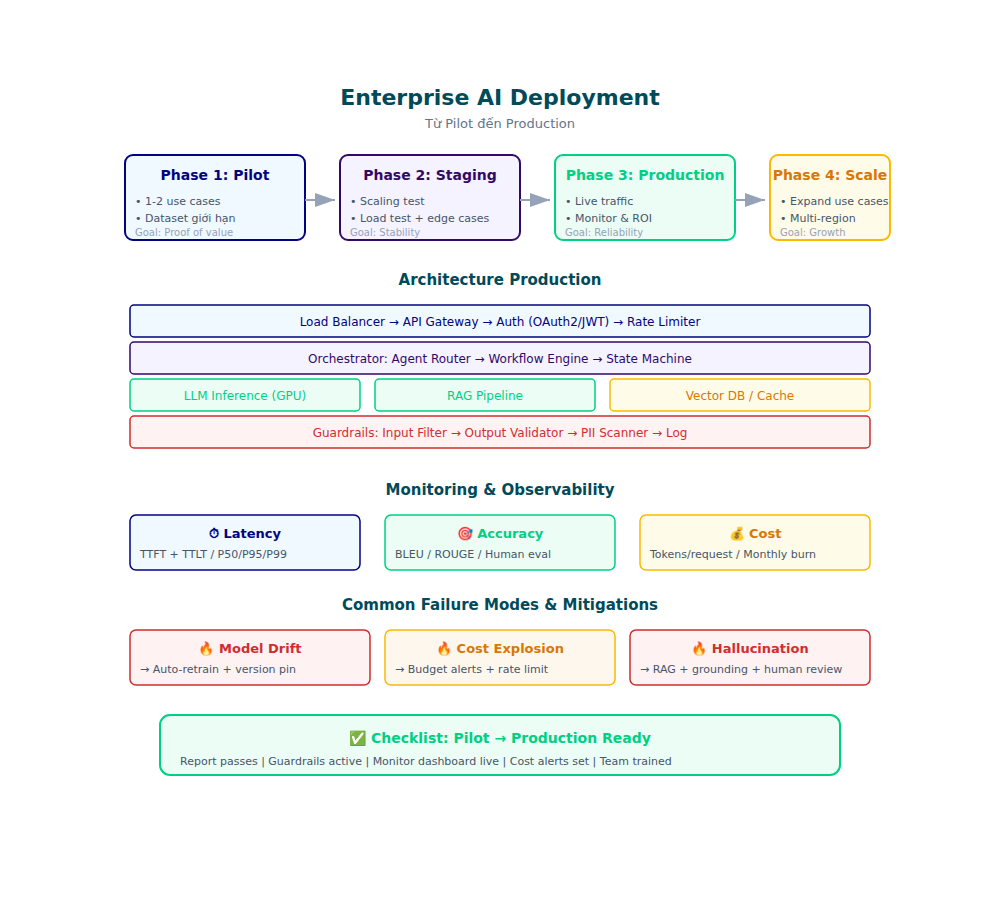
A system AI production deployment success requires the right architecture from the beginning. Microservices don’t have to be complicated—but they do require clear layers, each of which can scale and change independently.
Layer Architecture
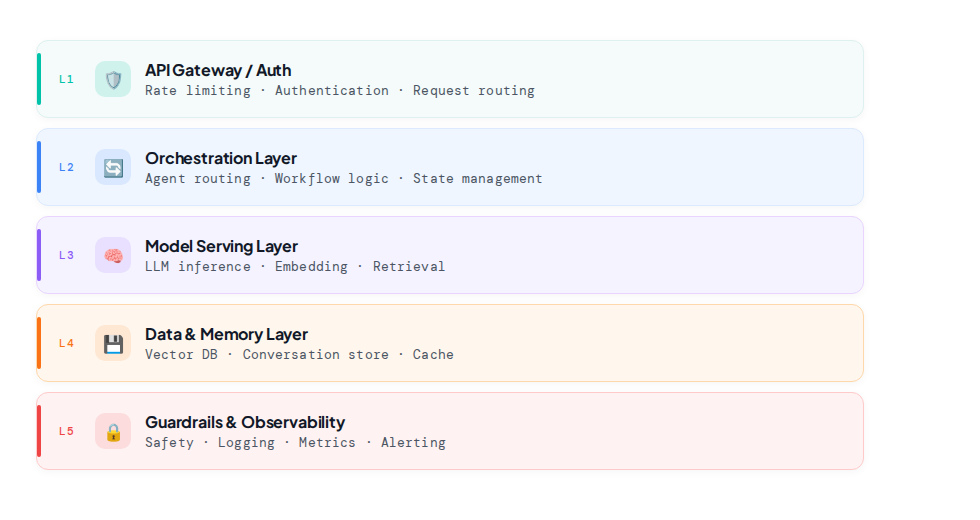
Each layer can be scaled independently. That’s the most important thing when AI agent scaling—you don’t want the whole system to crash because the inference model is slow, and you also don’t want to throw more GPUs just because the DB vector needs more RAM.
Details of Each Layer
API Gateway: Choose Kong, Traefik, or even Envoy sidecar. Needs rate limiting per-tenant, authentication (API key, OAuth2, or JWT), and request routing. Don’t skip this layer—it’s your first line of defense against abuse. An enterprise customer can send 10,000 requests/minute during peak hours, while the free tier needs to be limited to 100 requests/minute. Without a gateway, you are opening the door to all types of abuse.
Orchestration Layer: This is where AI Agent Architecture decides how agents communicate. LangGraph, CrewAI, or custom orchestrator—depending on complexity. It’s important that orchestration be stateless, with state stored in the layer below. When needed AI agent scaling From 1 agent to 10 agents running in parallel, stateless orchestration allows horizontal scaling without the need for distributed lock or complex coordination.
Model Serving: Self-hosted (vLLM, TGI) or managed (OpenAI API, Anthropic API, AWS Bedrock). Mixing the two is normal—critical path uses self-host to control latency and cost, fallback uses API for burst capacity. Key metrics: time-to-first-token (TTFT) for streaming use cases, and tokens-per-second for batch processing.
Data & Memory Layer: Vector DB (pgvector, Qdrant, Weaviate) for RAG. Redis or Dragonfly for conversation cache. PostgreSQL for structured metadata. Don’t use one database for everything—each type of data requires different optimization. pgvector is great for <1M vectors with PostgreSQL team already, but Qdrant or Weaviate is better for >10M vectors with real-time filtering.
Guardrails & Observability: This layer wraps around the entire stack. See also the article Security & Guardrails for AI Agents to understand how to implement it. Guardrails must run before and after the inference model—input filtering first, output validation second.
From Pilot To Production: 4 Stages
Phase 1: Proof of Concept (2-4 weeks)
Goal: confirm AI can solve specific problems, with measurable outcomes.
What to do:
– Choose a narrow use case with a measurable outcome (eg classifying support tickets with >80% accuracy)
– Use API directly (OpenAI, Anthropic, Gemini)—no need for self-hosting
– Prompt engineering, not fine-tuning—this is too early for fine-tuning
– Eval on 50-100 samples manually, with clear rubric
– Document everything: prompt versions, eval results, failure modes
Do nothing:
– Don’t build complex infrastructure
– Do not over-engineer pipeline
– Don’t optimize for scale—not needed yet
– No fine-tune model—prompt engineering is not enough, fine-tune won’t help
Exit criteria: Model achieved >80% accuracy on eval set, stakeholders agreed to continue investing. If not—stop, analyze failure, pivot or kill project. Don’t throw good money after bad.
Phase 2: MVP Production (4-8 weeks)
Goal: bring AI to production to serve a small group of internal users, collect real feedback.
Changes compared to PoC:
| Aspect | PoC | MVP |
|---|---|---|
| Model access | Hardcoded API key | Auth gateway, per-tenant |
| Observability | Print logs | Structured logging, metrics dashboard |
| Error handling | Try/catch basic | Retry logic, circuit breaker, fallback model |
| Data | Static files | Database with migrations |
| Deployment | Manual | CI/CD pipeline, staging environment |
| Evaluation | Manual | Automated eval pipeline + golden dataset |
Key decisions at this stage:
– Choose orchestration framework (LangGraph, custom)—it will be difficult to change later
– Set up structured output (JSON schema validation)—model output must be parsed reliably
– Implement basic guardrails (input/output filtering)—no need for sophisticated, but must have
– Set up cost tracking per request—you need to know exactly how much each user is spending
– Set up eval pipeline—golden dataset + automated comparison
Exit criteria: Serving <100 internal users, uptime >99%, P95 latency <5s, cost per request tracked and within budget.
Phase 3: Scale & Harden (8-16 weeks)
Goal: ready for real traffic production, serving external users.
This is the place deploying enterprise AI gets complicated—and where most teams get stuck. Many teams focus on complexity at this stage, thinking “it works for 100 users, just need more servers.” Wrong. 100 users and 100,000 users are two completely different problems.
Scaling Model Inference
Horizontal scaling with model replicas:
– Deploy N replicas model serving instances
– Load balancer round-robin or least-connections
– Auto-scale is based on queue depth and latency—not CPU usage
– Batch requests when possible—batching 4 requests at once reduces costs by ~30% across multiple providers
Fallback chain cho resilience:
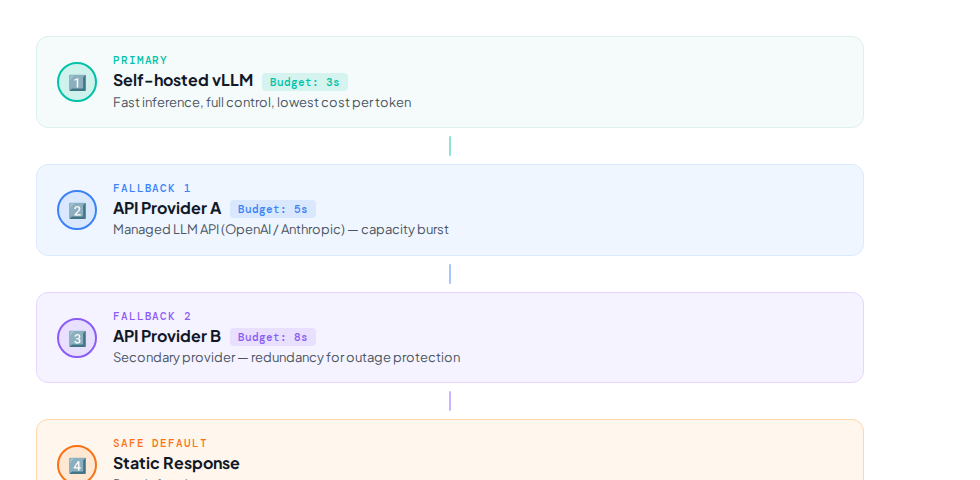
Each fallback has a latency budget. If primary does not respond within 3 seconds, switch to fallback. The user never sees an error—just sees a slightly slower response. This design also protects you from provider outage. When OpenAI goes down (and it will go down), the system automatically switches to Anthropic or self-hosted backup.
Model quantization cho cost efficiency:
– INT8 quantization reduces inference cost by ~50% with <1% accuracy loss
– INT4/GPTQ for deployment on smaller GPUs
– Dynamic batching: collect requests into batches to optimize GPU utilization
– Speculative decoding: use small model draft, large model verify—increase throughput 2-3x on some workloads
Scaling Data Layer
Vector DB needs dedicated attention—it is often the first bottleneck when AI agent scaling:
– Index type: HNSW for high recall (over 95%), IVF-PQ for large datasets with limited memory
– Sharding: by tenant or by data domain—no shard random
– Replication: read replicas cho query-heavy workload
– Reindexing strategy: incremental index update instead of full rebuild
Conversation store needs TTL policy—does not keep conversation history forever. 30 days is a reasonable default for most use cases. GDPR and data retention policies require you to have a mechanism to delete old data.
Cost Management
AI inference is expensive. There’s no easier way to say it. A GPT-4-class model that handles 1 million requests/month with an average of 2,000 tokens per request can cost $8,000-15,000 for inference alone.
Average cost for 1 million requests/month:
– LLM inference: $2,000-8,000 (depending on model and prompt length)
– Embedding generation: $200-500
– Vector DB hosting: $300-800
– Infrastructure (compute, network): $500-2,000
Cost optimization—real battle:
– Cache semantically similar queries (embedding similarity >0.95)—can reduce request volume by 20-40%
– Choose the right model size for the task—no need for GPT-4 for classification, GPT-4o-mini or Claude Haiku is enough for 80% of use cases
– Batch embedding requests—send 100 embeddings at once instead of 100 separate calls
– Token counting and budgeting per tenant—set hard limit
– Prompt compression for long contexts—reduce 50% of tokens while preserving semantic meaning
– Implement tiered serving: premium users use large model, free tier uses small model
Phase 4: Enterprise Grade (ongoing)
Goal: production-hardened, compliant, multi-tenant, ready for enterprise customers.
Multi-Tenancy Architecture
Each tenant needs:
– Data isolation — vector DB namespace or separate collection. Never share collections between tenants—this is a security requirement, not optimization
– Model routing — tenant A uses model X, tenant B uses model Y. Configuration-driven, no hardcode
– Rate limiting — per-tenant quotas, both request rate and token budget
– Cost allocation — chargeback according to actual usage. Finance team needs to know exactly how much each tenant costs
– Audit trail — all request/response logs for compliance. Not just for legal—also for debugging and improvement
Compliance & Governance
Big businesses require it enterprise AI deployment responded:
– Data residency — data does not leave the region. EU users → EU data centers, US users → US data centers. There are no exceptions
– PII handling — detect and redact before sending to LLM. DLP (Data Loss Prevention) is a must-have
– Model versioning — know exactly which model handles which request and when. Model registry like MLflow or custom solution
– Rollback capability — revert to old model version in <5 minutes. No <5 minutes = not fast enough for production
– Audit logs — immutable, sufficient retention for SOX/HIPAA/GDPR. 7 years for financial, 6 years for healthcare
SLA Framework
Define clear SLA for AI production deployment:
| Metric | Target | Measurement |
|---|---|---|
| Availability | 99.9% | 5xx rate, uptime |
| Latency P95 | <3s | Request duration histogram |
| Latency P99 | <10s | Request duration histogram |
| Error rate | <0.1% | Non-2xx responses |
| Model accuracy | >90% | Periodic eval on golden dataset |
| Time to recover | <15 min | MTTR from alert |
SLAs must be reviewed quarterly. Model accuracy decay is natural—data drift, concept drift, adversarial inputs all contribute. Set threshold, alert when near, and have playbook for each scenario.
Monitoring & Observability
Without monitoring, you don’t have a production system—you just have a running system and you don’t know if it’s working properly. Especially with AI, where the model can “silently fail”—returning a valid but semantically incorrect response.
3 Pillars of AI Observability
1. Metrics (number):
– Request count, error rate, latency distribution (P50, P95, P99)
– Token usage per model, per tenant—critical cho cost control
– Cost per request—alert when budget is exceeded
– Cache hit rate—optimization signal
– Model inference queue depth—capacity planning signal
– Custom business metrics: task completion rate, user satisfaction proxy
2. Logs (details):
– Structured JSON logs for each request—machine-readable, searchable
– Includes: model, prompt tokens, completion tokens, latency, status, tenant ID, request ID
– Sample logs for error cases (don’t log all—too expensive and difficult to search)
– Correlation ID to trace requests across multiple services
– PII redaction before logging—this is a compliance requirement
3. Traces (stream):
– Distributed tracing for multi-step agent workflows—this is where OpenTelemetry shines
– See exact time spent at each step: retrieval, prompt construction, inference, post-processing
– Identify bottleneck: slow vector search? Model inference? Or orchestration overhead?
– Trace helps debug problems that metrics and logs don’t show—for example, an agent call takes 8 seconds but you don’t know how the time is allocated
Alerting Strategy
Alert on business impact, not infrastructure metrics. 90% CPU is not important if P95 latency is still <1s. The P99 latency increase from 3s to 10s is important—even if the CPU is only 30%.
- Critical (wake on-call): Error rate >1% in 5 minutes, P99 latency >30s, model endpoint completely down
- Warning (next business day): Cost per day increased >50% compared to baseline, cache hit rate <30%, eval score decreased >5%
- Info (weekly report): New model version deployed, eval score changed >2%, traffic pattern shift
Evaluating AI Systems In Production
Eval does not end when the model deploys. Continuous evaluation is a requirement, not a nice-to-have. Model degradation is the problem when, it’s not if.
Offline Eval vs Online Eval
Offline evaluation (before deploy):
– Golden dataset with labeled examples—at least 200 samples, ideally 1000+
– Automated comparison: new model vs old model on all dimensions
– Regression testing: the new model cannot be worse than the old model on any dimension—no exceptions
– A/B metrics: accuracy, relevance, safety, latency, cost
– Adversarial testing: try to break model with edge cases
Online evaluation (sau deploy):
– User feedback (thumbs up/down, rating, correction)
– Proxy metrics: conversation completion rate, task success rate, time-to-resolution
– Model-based evaluation: use LLM to evaluate the output of other LLMs—cost-effective without human labelers
– Distribution monitoring: drift detection on input/output features—statistical tests like KL divergence, PSI
Eval-Driven Deployment
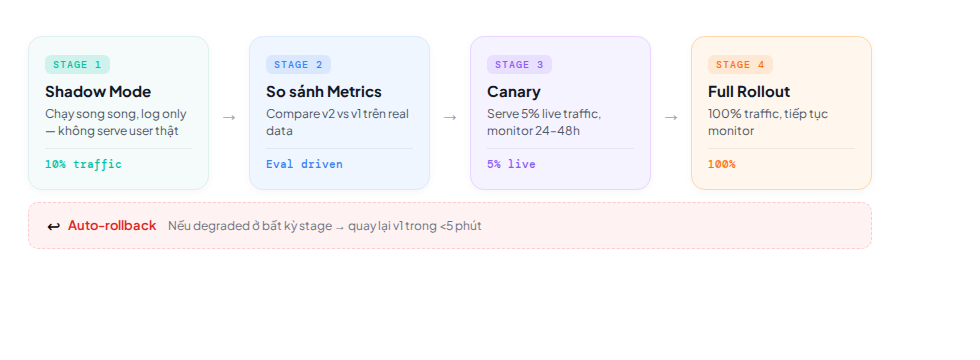
This procedure applies to both prompt changes and model swaps. Changing the prompt also changes the model behavior—it requires identical eval and canary. Many teams make the mistake of deploying prompt changes without eval, then realize 2 days later that quality has dropped 15%.
Shadow mode is especially important—it allows you to compare new and old models on real traffic without affecting users. Log output of the new model, compare with the old model, see how many cases the new model is better/worse. Only promote when data proves improvement.
Common Failure Modes & Mitigations
1. Prompt Injection & Jailbreaking
Production AI yes has guardrails. Not optional. Every week there are 1-2 new prompt injection techniques—defense must constantly evolve.
See Security & Guardrails for AI Agents for full understanding, but in short:
– Input filtering: detect and reject malicious prompts before sending to the model
– Output filtering: scan response before returning to user—check PII, harmful content, hallucinated facts
– System prompt hardening: clear boundaries, no instruction leakage
– Rate limiting: prevent brute-force attacks and resource exhaustion
– Prompt injection detection classifier: train lightweight model to detect injection attempts
2. Context Window Overflow
Khi AI agent scaling in production, the conversation context can unexpectedly exceed the model limit—especially with multi-turn agents or RAG-heavy workflows:
– Implement context window monitoring—log context utilization ratio
– Auto-summarize when context reaches 70% limit—don’t wait until 90%
– Truncate intelligently—keep system prompt + recent turns + compressed history
– Set hard limit: reject request if context will exceed model max, instead of sending and receiving error
3. Hallucination in Production
Cannot completely eliminate, but significantly minimize:
– RAG with verified knowledge base—model only references validated sources
– Confidence scoring—model indicates when uncertain, and system fallsback gracefully
– Human-in-the-loop cho high-stakes decisions (financial, medical, legal)
– Fact-checking layer for numeric claims—cross-reference with database
– Citation requirement: model must cite source for all factual claims
4. Cost Explosion
A bug in the prompt template could double token usage. A user abusing the API can burn thousands of dollars in an hour. Especially with agentic systems—an unterminated agent loop can call the model hundreds of times in a few minutes.
- Set per-tenant daily budget with hard cutoff
- Alert when cost exceeds threshold—both absolute and rate of change
- Implement request prioritization—free tier is throttled before paid tier
- Regular cost review and optimization sprint—monthly, not quarterly
- Agent loop detection: set max iterations per conversation, max total tokens per session
5. Vendor Lock-in
Depend on a single LLM provider = single point of failure. When the provider is down, you are down. When the provider increases the price 3x, you have no leverage.
- Abstract model access via interface, no direct API calls—changing provider only requires updating the adapter, no rewriting business logic
- Maintain fallback providers—minimum 2, ideal 3
- Self-host at least 1 model for critical path—Llama 3, Mistral, or smaller model for simple tasks
- Negotiate contract with multiple providers—volume discount + redundancy
Team & Process
Necessary Roles
AI Platform Engineer — build and maintain serving infrastructure, pipeline, monitoring. No PhD needed—solid engineering skills needed. This Person understands Kubernetes, networking, observability stack. They are the bridge between AI research and production reality.
ML/AI Engineer — develop and eval models, prompt engineering, fine-tuning. Need to understand ML fundamentals but no research-level required. Key skill: ability to eval model output systematically, not vibe-checking.
Product Manager (AI) — bridge between business and technical. Define use cases, prioritize features, measure outcomes. You must understand AI deeply enough to know what is feasible and what is hype. This person needs to be able to say “no” to stakeholders when the use case is not appropriate.
SRE for AI — traditional SRE + understand AI-specific failure modes. On-call when the model is degraded, not just when the server is down. Understanding that model returning 200 but semantically incorrect is also an incident.
Deployment Process
- Dev → Develop locally with small dataset, unit tests for prompt logic
- Staging → Deploy to staging, run integration tests + eval on golden dataset
- Shadow → Run production in parallel, log only, not serve users—compare output
- Canary → Serve 5% traffic, monitor metrics trong 24-48h
- Production → Full rollout, continue monitoring
Each step has clear exit criteria. Do not skip steps—especially shadow mode, because it catches problems that staging cannot (real data distribution, real traffic patterns, real edge cases).
Checklist: Pilot → Production
Before moving from pilot to production, verify each item. There are no optionals—all of these are must-haves.
Infrastructure
- API gateway with rate limiting and authentication (per-tenant)
- Model serving with health checks and readiness probes
- Database backups and disaster recovery plan (RPO <1h, RTO <4h)
- CDN for static assets (if UI is present)
- SSL/TLS for all connections—no exceptions
Reliability
- Circuit breaker cho external dependencies (model APIs, vector DB)
- Fallback model chain with latency budget per fallback
- Graceful degradation when model unavailable—return cached response or simplified output
- Auto-scaling policy defined and tested under load
- Rollback procedure documented and rehearsed—team must practice at least once
Observability
- Structured logging for all requests (JSON format, PII redacted)
- Metrics dashboard (latency, error rate, cost, per-tenant breakdown)
- Alerting on business metrics, not just infrastructure
- Distributed tracing for agent workflows (OpenTelemetry or equivalent)
- Cost tracking per tenant with budget alerts
Security
- Input/output guardrails deployed and tested
- PII detection and redaction
- Authentication and authorization (RBAC for multi-tenant)
- Audit logging cho compliance (immutable, proper retention)
- Penetration testing completed—specifically for prompt injection
Governance
- Model versioning in registry (MLflow or custom)
- Eval pipeline for model changes—automated, not manual
- A/B testing framework ready
- Data governance policy documented and approved
- Incident response playbook cho AI-specific issues (hallucination, injection, cost spike)
Resources
Process enterprise AI deployment need the right tools. If you’re looking for a coding AI solution to support your deployment workflow—writing deployment scripts, debug production issues, generating monitoring configs—then Deploy AI agents with GLM (GLM Coding Plan, $18/month) is an option worth considering. This plan supports Claude Code, Cline, and more than 20 coding tools—perfect for engineering teams that need AI coding assistants in the deployment process.
Conclusion
The gap between pilot and production is not a purely technical issue—it is an engineering discipline issue. You need the right architecture, adequate monitoring, tight processes, and a team with the right skills. Tech stack changes, but principles do not.
Points to remember:
- Right start — architecture layer from day 1, not after scaling. Changing architecture after traffic is already there is more expensive than building it right from the start
- Measure everything — metrics, logs, traces, costs—no blind spots. You cannot improve what cannot be measured
- Guardrails are not optional — security and safety are requirements, not nice-to-have. Every week there are new injection technique prompts—defense must constantly evolve
- Eval continuously — deployment is not the end point, continuous evaluation is. Model degradation is when, it’s not if
- Process is as important as code — deployment pipeline, rollback procedure, incident response playbook—all of these needed before needed, not after needed
Deploying enterprise AI success is a marathon, not a sprint. But with the right architecture and the right process, you can run that marathon without giving up at mile 5.
Read more about agent architecture at AI Agent Architecture and how to protect systems at Security & Guardrails for AI Agents.